“In a Dark Time, the Eye Begins to See.” -Theodore Roethke
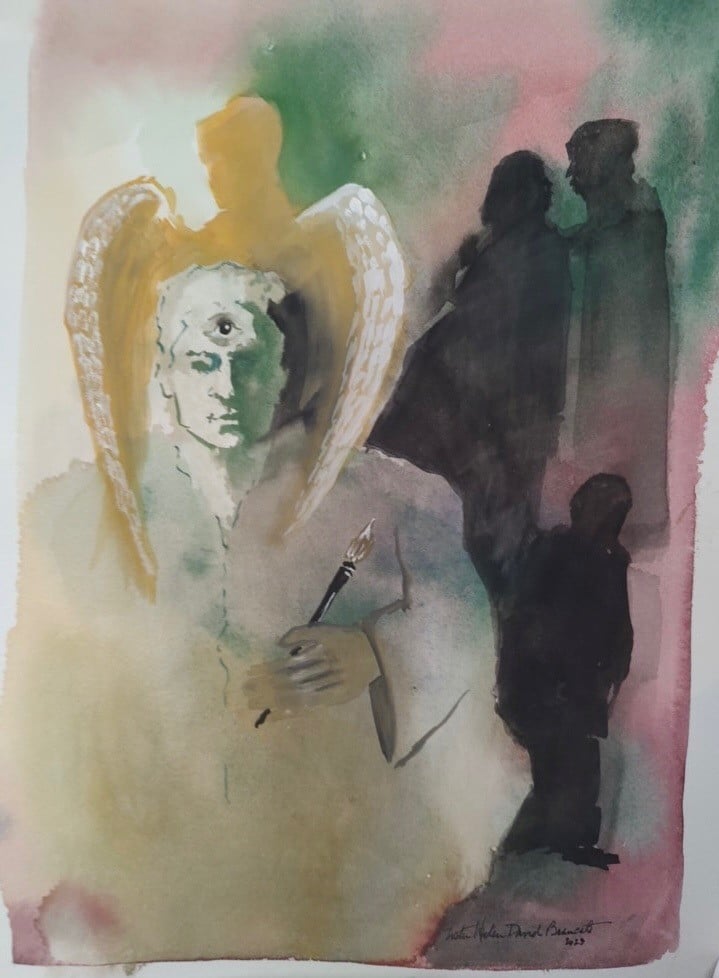
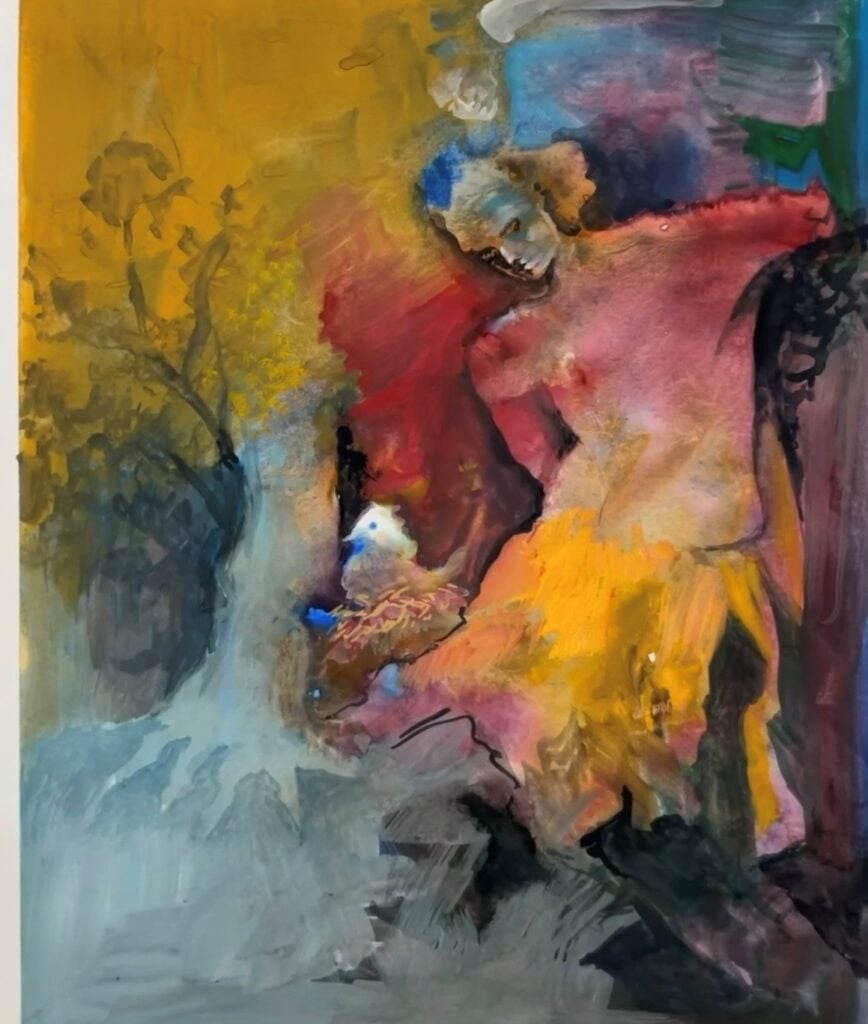
As an artist, I am intrigued by contrast. Many of my paintings emerge from very dark backgrounds, making the light stronger and more evident to the viewer. The following artists were not afraid of painting or drawing very dark backgrounds to convey what was going on in their world. Three wonderful artists come to my mind: Kollwitz, Rembrandt, and Caravaggio. The substance of Kathe Kollwitz’s art is dominated by compassion and strength, with a deep understanding of the misery of her neighbors, the oppressed. She lived through a dark time in Germany and expressed a deep concern for humanity through her prints and drawings. Her powerful sketches were prophetic. Rembrandt’s painting, “The Return of the Prodigal Son,” uses a very warm, inviting balance of light and darkness. Caravaggio’s “The Crucifixion of Saint Peter” has an interplay of shadow and light. I sometimes think that artists have a “Third Eye” and see the world very differently from others. An example of this is my own personal experience during a retreat in Ocean Grove, New Jersey. I was able to paint during the retreat and created many abstract backgrounds depicting my inner feelings. At that time, I had just experienced a loss of confidence in my life and in my artwork. Gazing at one of the dark backgrounds, I saw a figure stripped of her confidence. But out of the darkness, there appeared a beautiful white dove offering HOPE to my wounded spirit.
Images often reveal so much about what a person sees in their own darkness. This experience led me to give workshops about using ink blots or shadows to reveal what is deep in our subconscious (like the Rorschach test). I purposely use black India ink for participants to discover the images they have created by dropping ink on a wet surface paper and letting the ink bleed. Once dry, studying the image from a distance, asking yourself the question, “What do you see in the shadows?”
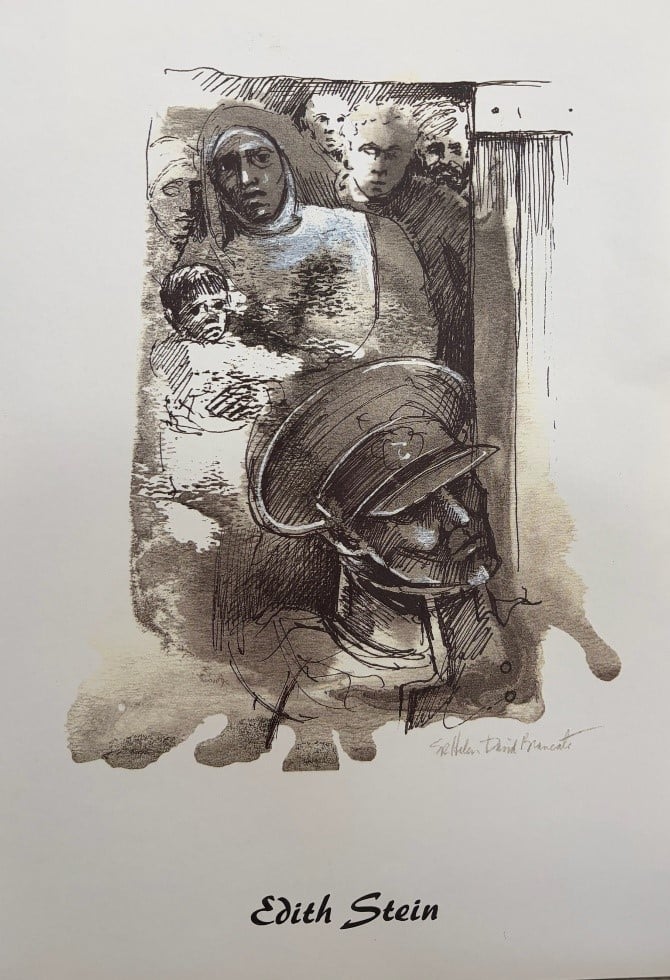
“A soldier from Cologne, a new recruit to form a postal unit in the eastern zone, waits in the depot as the door slides open on a freight car packed with people cowering. The stench is overpowering. A woman in nun’s clothing says to him, “This is my beloved hometown. I will never see it again. We are riding to our death.” – Evelyn Mattern
In 1999, Ave Maria Press printed a book titled “Why Not Become Fire? Encounters with Women Mystics.” It was my good fortune to reconnect with poet Sister Evelyn Mattern. She was very interested in writing about women mystics and wanted to combine poetry and art. The two of us met in North Carolina and discussed the book process. We both agreed that the artist’s process emulates the mystic’s. The presence of God was found in the shadows. The art form mirrored the mystic’s. Evelyn Mattern said, “The mystic waits for God in darkness and has no fear of the shadows.”
Since we lived at a distance from each other, we agreed to complete the book by mail. I would send 20 ink blots to Evelyn, and she would put them on her wall. Then she would write a poem about each one and send it back to me. This led to the publication of “Why Not Become Fire?” It was a wonderful, creative venture for both of us.
“Mystics, poets, and artists learn to wait, to trust, and to rely upon the darkness just as nature has always depended on it. Nature folds the dark into waiting periods for events like birth and dawn and harvest and sunset.” – Evelyn Mattern
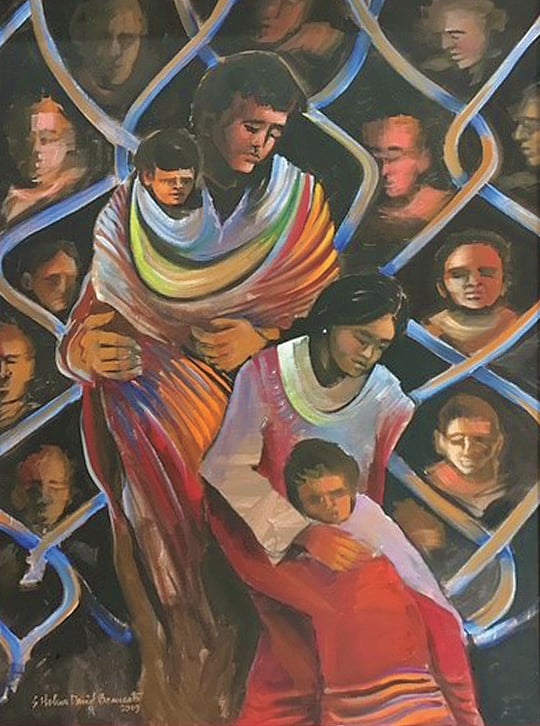
Third Eye by Helen David Brancato, IHMStripped of My Confidence by Helen David Brancato, IHMEdith Stein by Helen David Brancato, IHMImmigrant Family by Helen David Brancato, IHM
About the Artist
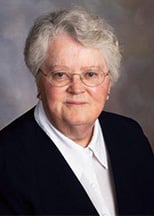
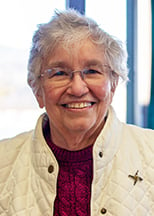
Sister Helen David Brancato, IHM studied portrait painting at the Pennsylvania Academy of the Fine Arts and a variety of visual art forms at The Tyler School of Art of Temple University. Working as a painter, printmaker, and illustrator, she has exhibited professionally primarily in the Philadelphia and New York areas, and taught visual arts at Villanova University. She collaborated as illustrator with Henri Nouwen on Walk with Jesus: Stations of the Cross and with Evelyn Mattern on Why not Become Fire?: Encounters with Women Mystics. But one of her major accomplishments has been guiding artists from six to eighty years of age in an open studio at the Southwest Enrichment Community Art Center in Philadelphia.
She is the recipient of an Independence Foundation Artist Fellowship, and her work is in the collection of The Museum of Contemporary Religious Art at Saint Louis University and Villanova University. Sister Helen David’s artist’s statement resonates beautifully with her mission: “My work is bound up with the human condition. I respond to nature peacefully and to human nature with healthy agitation. It is important for me to interact with the lives of the poor. Through painting, I try to bring the depth of my insight into the pain, the strength, and the dignity of my subjects.”