Journey
Confronting Our Fears
Confronting fear is like tearing through a dark tunnel in a 90-mph bobsled, clinging for dear life.

Somewhere in the 1980s, when we could still manage some vigorous hiking, four of us went on vacation, driving through the Blue Ridge Mountains of Virginia and as far as the Great Smoky Mountains. On our way home, we resolved to stop and crown our days with a hike through the famous Lourey Caverns. Two of our more senior companions opted to wait for us above ground at the mouth of the cave and “hear about” our underground adventure.
As part of the orientation to the hike, our guide offered us an option—a silent sit in a motionless pitch-black cavern. We actually chose that option! It was an astonishing experience raising an incredible range of emotions from immobilizing terror to a feeling of smothering to finally halting slowly into eternal peace. A peace like that in the dark seems softly luminescent and otherworldly.
Confronting fear is like tearing through a dark tunnel in a 90-mph bobsled, clinging for dear life. It’s never a single action; it’s a transformation that feels like gulping terror and anticipating a smacking impact into the airless tunnel and gradually fading into a free-floating fall toward total obliteration, but finally landing gently in a magnificent, peaceful wholeness of soft dawning light. It’s a process of coming to gradual, enlightened peace that says with great wonder: “I’m OK. I’m OK.” Like the slow emergence of a rainbow from the darkest cloud of a storm, my spirit breathes, “Ahh-how beautiful!”
Once in a hospital during an illness, I hemorrhaged so badly that I lost consciousness and experienced a feeling that my life was slowly draining away. Then out of a hollow, cave-like darkness, I heard a tense but calm, breathy whisper: “I got it: I got a pulse.” I heard it several times more in the ICU that night, and each time I felt closer to safety, the kind that comes with trust and surrender into the gentle hands of another.
It’s akin to some of the gospel experiences of Lent, where the terrified apostles, being roughly tossed about in their fragile fishing boat, cried out to awaken the sleeping Jesus, screaming, “Save us! Save us!” Yes, because at the very core of their being, they knew that with the presence of Jesus, nothing could ultimately destroy them. In another Lenten gospel of the transfiguration, terrified men, hugging the ground, came to believe on that crest of a mountain, that this man, Jesus, their friend and teacher, was truly the Son of God who could subdue their fears and misconception and walk with them down the mount to embrace the mission that would fill their lives and eventually take them to their deaths. Jesus’ transfiguration transformed them from fearful creatures to courageous disciples, living perpetually in the abiding presence of everlasting love, care, and personal protection. Finally, having experienced the transfigured Jesus, their inner knowing becomes clear. “Their Jesus is truly God, and in God, all things are possible.”
Facing fear involves feeling it, seeing it for what it is, walking through the dreads, discovering with confidence who I am and whose I am, and trusting my existence is held firmly and safely in sacred hands.
When we were young sisters, a beautiful artist from a war-torn Lebanon gave us a lecture. Day and night, warning sirens were going off signaling imminent danger and sudden death. With each siren, she’d quickly hide her paintings under a bed and go quietly to the sheltering hall of the hospital where she lived. Huddling silently against the wall, she waited for peace to come, but her many weeks and months of terror took her beyond her fear to see what she most valued in life and what she least wanted to surrender.
We asked how she did that. “When you come to trust, you are grasped forever by unending love, you begin to live beyond fear in incredible freedom of spirit.” She learned that she was always grasped by life, either here or beyond, and that her eternal spirit is indestructible. No matter what, she lives as God lives; she lives “through God and with God and in God, always.”
How am I learning to confront my fears? I am learning to embrace the subtle art of transformation—I learn from suffering cruel hurts, surviving tragedy, tending to gut-wrenching grief, languishing in spiritual poverty, dryness, loneliness, longing, unraveling and slowly encountering the velvet touch of blackest darkness, but also discovering the gifts of darkest nights’ stars, moon, planets, the Milky Way, wonder, rest, shadows and thresholds, dreams and dancing. I am coming to believe that one doesn’t necessarily have to boldly confront fear but can learn to walk quietly beside it in lock step, matching the rhythm of imperfect humanity like the Irish step-dancers in a parade. Breathe step, breathe step, one, two, three. Fear, who has become my teacher, reveals to me what is most dear and what I don’t want to surrender: life and loving; working and thriving, confiding in friends and standing by them, reaching out with integrity and compassion; praying for mercy; finding peace in the face of bad news, sickness, and even death.
On NPR radio, I listened to an inspiring interview with many young Ukrainian adults in Kharkiv. Despite all the death and bombing, the rubble and terror, the youth wish to live life, celebrate life, and when the sun comes out, they meet and eat, and dance in their broken streets. In Ukraine’s second-largest city, the remote yet real possibility of dying hasn’t stopped many of its residents from living. It can be scary, say the students in Hemingway’s Bar as they quote its namesake: “Life always defeats death; the sun always rises.”
Welcoming the light that darkness makes!
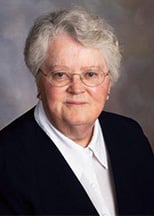
Sister Kathy serves as the Delegate for Religious for the Diocese of Scranton and as a part-time editor in the IHM Communications Office. Her favorite ministry, though, is part-time teaching English to new immigrants in the IHM free program, Everyday English for Adults.