Journey
Grief, Loss, and Light: Some Reflections
Read about how you can overcome grief and loss in your life.

Grief is the experience of coping with loss, and both come into everyone’s life, sometimes in devastating ways, sometimes in small losses that surprise us by the force of grieving that ensues.
Coincidences come into every life as well. In the days since Sr. Fran Fasolka invited me to write this article, several decisions requiring change have happened in my life. I needed to withdraw my name as chapter delegate and officially indicate my need to remain permanently at Our Lady of Peace Residence. I need to begin a major downsizing of belongings that were stored easily at St. Joseph’s Center but will not fit here at OLP. Adjusting to life at OLP is an ongoing process; dealing with limitations in my mobility has been and continues to take much of my attention.
McCoyd and Walter (2016) assume that change is a necessary and unending part of development, and that even positive change holds within itself some aspects of loss. They detail the effects of grief at every stage of life, including death and non-death losses. They also explain that a loss at one age may have repercussions at other ages. Loss of a parent as a child is the devastating absence of a caregiver to whom one is greatly attached; later, it is the absence of a supportive guide when one is an adolescent, and a grandparent to one’s own children later in life.
McCoyd and Walter present the physiological, psychological, and social aspects of grief and loss. Biological changes may involve neurological systems, genetic/epigenetic factors, immune systems, hormonal changes, and cardiological systems. Psychologically, grief involves sadness, rumination, psychic pain, and irritation. Challenges in coping may be due to cognitive changes, such as a lack of focus and clarity. An additional psychological effect is a heightened sense of vulnerability, similar to the effects of trauma. Each person must cope with this fearfulness and anxiety, which are not usually associated with grieving.
As we mentioned before, smaller secondary losses accompany major life changes and death experiences. This fact helps us to understand the holistic nature of coping. Moving to high school is an accomplishment; students and adults share pride in accomplishments. Nevertheless, some things are lost: closer ties with a smaller number of classmates, teachers who have greater contact with those in the classroom, and the familiarity of an environment one knew well. And the parents feel the loss of the child they could direct with little questioning, even as they rejoice in growth towards adulthood.
Psychological losses and the processes of grief seem to me to be intertwined. Examples of psychological losses include the following: loss of security, loss of identity, autonomy, belonging, loss of financial security; these may be losses in their own right. They are also the accompaniments of life-changing illness, injury, or death-related change, our own or that of a loved one.
One of the tasks that occurs as part of grieving is learning to adjust our view of the world. We all carry “assumptive” beliefs about reality. They may be unique to us, but often they are shared with others. We assume things about the world being fair. We assume things about who is liable to die and when. We make judgments about health and health practices. I remember a man who worked on having a very healthy lifestyle. He biked, exercised, and ate well. When he developed cancer in his 70s, he was quite angry at what he felt he should be able to avoid.
This brings me to two caveats: (1) Do not compare yourself to others. (2) If you have expectations, hold them with the uncertainty they deserve.
The Advice I Need
1. Remember that not everything has changed; also, attend to the positive aspects of even difficult changes. Cultivate gratitude.
2. I may need to examine and adjust some of my assumptions, including how I see my own identity.
3. God is God. Our attempts at control are normal and often healthy. It’s good to make wise decisions about health, exercise, and social interaction. However, God is still the one in charge, and our attempts to understand will fall short, even though we often cannot resist the human tendency to try to figure things out.
4. God is with us, on our side, understanding how we are made, both as humans and as the unique being each of us is.
5. No one is exempt. Each person has experienced, and will experience, grief and loss. Often, we do not know of another’s pain. Sometimes, when we do, we don’t understand it. We need to have as much compassion as we possibly can, for ourselves and for each other. This is the journey we make with others; this is the journey that makes us one.
As Sister Patt Walsh is fond of saying, “Coincidences are God’s way of being anonymous.” Perhaps the transitions I mentioned at the beginning of this article are not really coincidental with the invitation to write this article. There is one more ‘coincidence’ I’ll mention. I hope it leaves you with a sense of the presence of God.
A few weeks ago, I received a card created by an old friend, Noelie Kilmer Angevine. The painting on the card includes a narcissus, and the accompanying poem, also by Noelie.
Paper White
And then I saw the dark at night
That set the flowers and leaves
on kitchen windowsill in white.
Not bright enough,
Distracting me from paper on my table,
Piled with sliding mail
That hides my fruit,
Bowled in straw baskets.
Forms to fill,
Forms to mix in other forms,
To play a game of “Hide and Seek.”
The night is dark.
Turn off the light.
The drifting snow outside is soft.
The paper, darkened in my sight,
Turns into foothills
And between my work and snow,
Like sparks,
Narcissus stands and blesses me.
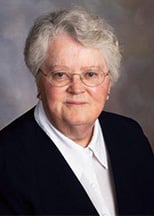
Sister Gail is a developmental psychologist and an adjunct professor at Marywood University.
References
Angevine, Noelie Kilmer. Paper White (poem). Used with permission.
McCoyd, J.L. M. & Walter, C. A. (2016). Grief and loss across the lifespan: A biopsychosocial perspective. NY: Springer.