News & Updates
Happy Birthday Mother Theresa Maxis, April 8, 1810
Celebrating the birthday of our Mother Theresa Maxis Duchemin

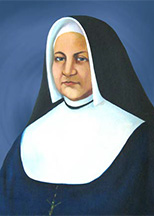
Early this century, Sister Sheila Reilly, IHM, was conducting oral history interviews. Sheila heard about Sister Reginald Gerdes, OSP, and her interest in Mother Theresa, so she asked to interview her. Reginald grew up in New Orleans and entered the Oblates in 1952. Sister Sheila learned that when Reginald was a postulant, she had “answered a question from her novice mistress, with such confidence because I was so proud I knew the answer” that the Sister told her, “You know you are just like Mother Theresa.” Sister Reginald never knew Mother Theresa Maxis Duchemin, but another novice of her community shared that she had been taught by Sister Suzanne McCarthy, IHM, in the IHMs’ “black” school in Upper Marlboro, MD. Sister Suzanne gave her a copy of Mother Theresa’s biography by Sister Immaculata Gillespie, IHM, probably when she heard that her student was entering the community of the Oblates, the first religious community of women of color in the United States.
“So, I took the book and read it. I was very much impressed with Mother Theresa, and I like her,” Reginald told Sister Sheila, “for the rest of my life I’ve been finding little bits about her.” Reginald spent two years at Xavier University in New Orleans where there was a large population from Santo Domingo.” I found out a lot about our own foundress and also something about the Duchemin family. What I found was that the French government had documents called indemnity papers whereby they reimbursed planters for whatever they lost in the revolution, and several Duchemin names appear there.” Margaret Gannon writes in Pilgrim that some of the Saint Domingue refugees were different from other persons of color in that they had preserved some of their wealth.”
Reginald shared the following about her own opinion of Theresa. “I’m much impressed with Theresa because she was ahead of her time. She knew what she was about, and she feared no mortal. She was very impulsive. She had that dignity about her because she knew who she was, and no one could take it from her. I can appreciate that because that’s how my grandmother raised me. She’d say to me, “You’re as good as anybody else, and better than most.”
Sister Margaret Gannon corroborates Reginald’s observation of Mother Theresa’s personality. She writes in Pilgrim, “In her more mature years, as she comes to assume leadership positions in the Oblates, she begins to write and act in ways that supply the historian with abundant evidence of her forceful and exciting personality.”
In 1841, Theresa was elected OSP Superior General. In 1843 Father Joubert died, and “financially distressed and deprived of the spiritual support of their earlier sponsors, the Oblate Sisters of Providence may have seemed to be on the brink of dissolution.” The letters and the written history seem to agree that Mother Theresa did say that she wanted to join a religious community–this while still with the Oblates. Reginald called Sister Sheila’s attention to the fact that when their foundation was recommended to Rome, the archbishop at the time designated them a pious society. Later on, Bishop Eccleston forbade the community from accepting new members and urged them to return to the world. Theresa did keep the community together during this time, but when she was not reelected to the position of Superior General, but as the assistant to the superior, she left nine months later for Monroe to begin a new foundation with Father Louis Gillet, CSsR. Another Redemptorist missionary, Father Egidius Smulders, engaged the Sisters in a new form of their educational mission, that of bringing girls from the outlying districts to Monroe to live at the school while they were preparing to receive the sacraments. During his directorship, the blue habit and the title Sisters, Servants of the Immaculate Heart of Mary were adopted. It was he who added the word servant to the title. Mother Theresa, in the preface to her prayer book, indicated that it was also Smulders who identified the spirit of the congregation as one of humility, simplicity, and devoted to charity. These values live on in our charism today.
N.B. It is believed that April 8 is the birth date for Theresa Maxis, but there is no civil record or documentation to substantiate this date.