News & Updates
Transforming Grace
Sisters Fran Fasolka, Donna Korba, Anne Munley and Annmarie Sanders were among the 264 participants from 107 communities of women religious who traveled to St. Louis, Missouri, to participate in the LCWR Transforming Grace II: Next Steps on the Journey, May 4–7. The goal of this second LCWR program was to strengthen the vital partnership among leaders, communicators, and justice promoters and to provide space and time to share, learn, plan, connect, and network.
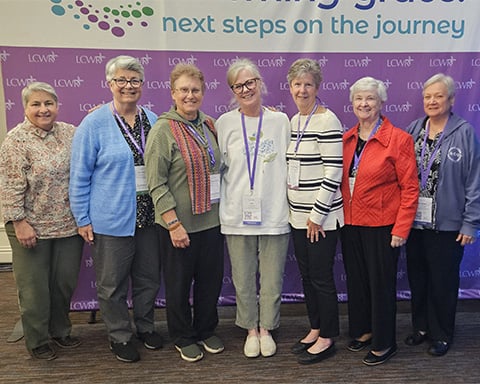
The gathering began with a World Café experience planned to facilitate open dialogue, share knowledge, and foster collective wisdom. Participants engaged with several table groups to explore meaningful topics and to “cross-pollinate” previous conversations.
The opening prayer on May 5, Cinco de Mayo (the celebration of Mexico’s victory over the French Empire in the battle of Puebla), featured remembrance of those who had gone missing or been murdered thus raising awareness about the violence that disproportionately affects Native communities. Speakers included David Spicer, Director of Policy and Engagement at the USCCB, who shared his own faith journey and its influence on his legal work in the area of immigration. He reminded participants of their immigrant heritage and the call for deeper engagement with our faith in response to current events. He noted that at a time when our culture is dominated by deep political divisions about immigration policy, progress can feel impossible. By witnessing to the God-given dignity of every person, including migrants and refugees, we can pave the way for policies rooted in mercy, justice, and the common good.
Michelle Sardone, the Deputy Director for Catholic Legal Immigration Network, Inc. (CLINIC), trains legal representatives who provide high-quality and affordable immigration legal services for more than 500,000 immigrants each year. CLINIC provides direct representation for asylum seekers at the U.S.-Mexico border and educates them about their rights; reunites formerly separated families; provides legal representation for those in removal proceedings and in detention; provides public education on immigration law and policies; and advocates for fair and just immigration policies that acknowledge the inherent dignity and value of all people. Michelle shared her faith journey that sustains her in ministry on behalf of her immigrant sisters and brothers.
Prior to the conference, preparation materials were provided to participants. Among them were videos by Irshad Manji, The Dilemma (with Big Think): https://tinyurl.com/ne5tbrns Irshad Manji is the founder of Moral Courage College, which equips people worldwide to turn heated issues into healthy conversations and sustained teamwork. Irshad engaged participants on the skills of Moral Courage® — a practice that heals social, cultural, and religious divides. She revealed the Moral Courage® method of engaging across divides and encouraged all participants to practice these skills, making a habit of them in order to “disarm” what she refers to as the “egobrain.”
- Breathe deeply. First through the nose, then out the mouth.
- Don’t merely seek common ground. Create it.
- Before making statements about what you believe, ask a sincere question about what your other believes.
- Listen to learn, not to win.
- Ask another question by starting with three simple words: “Tell me more…
Congregational teams of leaders, justice promoters, and communicators had opportunities to meet and engage with each speaker.
Participants also had the opportunity to watch interviews conducted by Sister Annmarie Sanders with Bishop Marianne Budde and E.J. Dionne. Bishop Budde serves as spiritual leader for the Episcopal Diocese of Washington D.C. E.J. Dionne is an internationally-recognized journalist, political commentator, thought leader, professor, former syndicated columnist for The Washington Post, and current contributor to The New York Times. Both spoke passionately about their desire to express their truth working from their faith-base while pursuing the common good.
Striving to integrate all that was experienced in prayer, input, reflection, and conversation, participants were asked to reflect upon, “What is stirring within you?” and, “How can you make what you have learned visible in the life of your institute?”
Participants met in congregational teams to converse about what their learning/experience meant for them and their institute. They discussed plans going forward to strengthen collaboration among leaders, justice promoters, and communicators.
The conference concluded with gratitude expressed to the planners, contributors, and participants. Going forth, appreciative participants prayed:
We gather because we believe
– in the power of the resurrection
– in the strength of Grace to transform
– in the conviction that together infinitely more is possible
– in the confidence that the Spirit dwells here in our midst
– in the courage necessary to discern the next step on a path
we have not walked
– in the trust we place in the solidarity of this community of
love
We gather to do something remarkable
– on behalf of the communities who have drawn us
– on the shoulders of those who have gone before us
– in response to the urgency of the most vulnerable
– in response to the calls we have experienced
– in solidarity
– in love
Not for ourselves do we gather, but for the generations to follow.